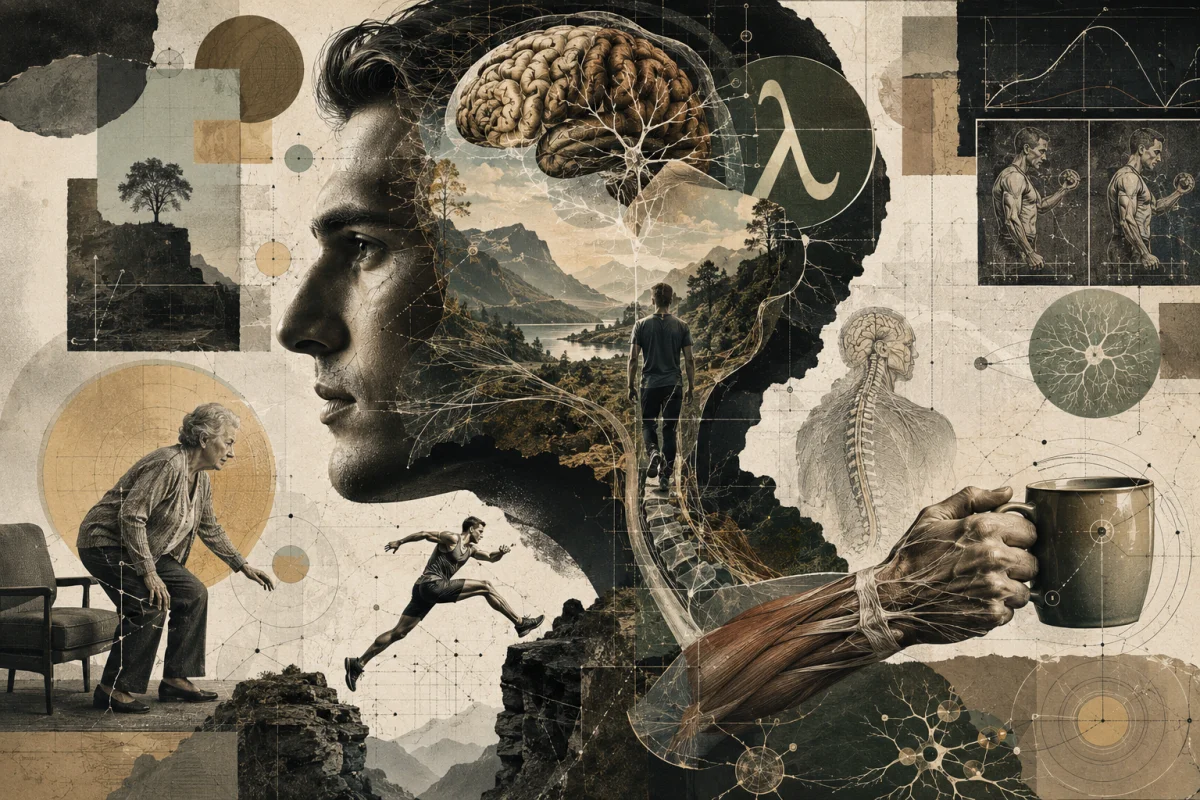
Lambda: The Hidden Variable Behind Every Move You Make
You just picked up your coffee mug. Simple, right?
Your fingers wrapped around it at exactly the right pressure. Your arm lifted it smoothly. Your elbow bent to just the right angle. All of this happened in less than a second, without you thinking about a single muscle.
But somewhere in your brain, something had to make all of that happen. And for most of the 20th century, scientists had the wrong idea about what that "something" was.
The Old Idea: Your Brain as a Puppet Master
For a long time, the dominant thinking was straightforward: your brain sends electrical signals to your muscles, and those signals tell each muscle exactly how hard to contract. More signal equals more force. Less signal equals less force. Your brain is the puppet master, your muscles are the puppets.
It sounds logical. But there's a problem.
If your brain directly controls how much each muscle contracts, then why, when someone suddenly takes a heavy weight out of your hand, does your arm fly upward even if you try to stop it? Your brain wanted to keep contracting. But the muscle didn't listen. Something overruled your intention.
That "something" turned out to be far more interesting than anyone expected.
The Reflex You Can't Override
Your muscles are full of tiny sensors called muscle spindles. Their job is simple: detect when the muscle is being stretched, and fire a signal back to make it contract.
This is the stretch reflex. You've seen it in action, it's what happens when a doctor taps your knee with that little rubber hammer. You didn't decide to kick. The spindle detected a stretch, sent a signal to the spinal cord, and your leg moved, all without your brain being involved at all.
Here's the thing scientists gradually realized: this reflex doesn't switch off when you decide to move voluntarily. It's always running. In the background, constantly, your muscles are monitoring their own length and reacting to it.
Which means your brain isn't a puppet master sending direct orders. It's more like a thermostat programmer, setting the conditions under which the system responds on its own.
Enter Lambda
In the 1960s, a Russian physiologist named Anatol Feldman proposed something radical. He said:
Your brain doesn't control how much your muscles contract. It controls the threshold at which the stretch reflex kicks in.
He called this threshold lambda.
Think of it this way. Your bicep muscle has a length, how stretched out it is. Lambda is the specific length at which your nervous system says "okay, start contracting now." If the muscle is longer than lambda, the stretch reflex fires and the muscle pulls itself shorter. If the muscle is already shorter than lambda, the reflex stays quiet and the muscle relaxes.
Your brain moves your arm not by ordering the muscle to contract, but by shifting lambda.
When you decide to bend your elbow, your brain quietly moves lambda to a shorter length. Now the muscle, at its current length, finds itself "too long" relative to the new threshold. The stretch reflex fires automatically. The muscle contracts. Your arm bends. When it reaches the new lambda, the reflex quiets down. Movement stops.
You didn't control the contraction. You controlled the target. The reflex did the rest.
What This Looks Like in Real Life
Imagine you're doing a bicep curl with a dumbbell.
On the way up (concentric phase): Your brain shifts lambda to a short length, shorter than your arm currently is. The stretch reflex fires hard. Your bicep contracts, pulling your arm up toward that new threshold.
Holding at 90 degrees (isometric phase): Your brain keeps lambda right where it is. The muscle sits at exactly the length where reflex activity and the weight of the dumbbell perfectly balance each other. No movement, but constant tension.
On the way down (eccentric phase): Your brain slowly shifts lambda back toward longer lengths. As it does, the reflex activity gradually decreases. The weight pulls your arm down. But because your brain is moving lambda slowly, the descent is controlled, not a free fall.
At no point did your brain say "contract at 60 percent of maximum force." It only said "here is the threshold, the rest is physics."
Why This Changes Everything for Movement and Rehab
Once you understand lambda, a lot of things that seemed mysterious start to make sense.
Muscle tightness isn't always a structural problem in the muscle tissue itself. Often, it's that the nervous system has set lambda to a very short length, the muscle's "default comfortable position" has shifted toward contraction. Stretching the tissue won't fix this. You need to teach the nervous system that longer lengths are safe.
Muscle weakness in rehab often isn't about the muscle being damaged. It's about the brain having "forgotten" to include that muscle in movement patterns. The lambda settings have been abandoned. Isolated exercises help, but the real fix is reintegrating the muscle into whole-body movement until the brain starts using it automatically again.
Range of motion isn't primarily limited by how stretchy your muscles are. It's limited by when your nervous system decides to resist further movement. The reflex in the stretching muscle starts fighting back. This is why passive flexibility (how far someone else can push your limb) and active mobility (how far you can move it yourself) are completely different things, and why active mobility is the one that actually matters for movement quality and injury prevention.
The Bigger Picture
The lambda model revealed something profound about how living movement works: the brain sets intentions, not commands.
A thermostat doesn't tell the furnace to burn at exactly 40 percent capacity. It sets a temperature. The furnace responds to the gap between current reality and that target. The system finds its own equilibrium.
Your muscles work the same way. Your brain sets a threshold. Your reflexes close the gap. The result is movement, fluid, adaptive, self-correcting, requiring far less computational effort than if your brain had to micromanage every fiber.
This is why movement feels effortless when you're skilled at something. You're not thinking less, your brain has simply learned to set lambda with precision. The reflexes handle the details automatically.
And it's why relearning movement after injury is so hard. It's not just muscles that need to heal. It's thresholds that need to be reset, one repetition at a time.
The next time you pick up your coffee mug, remember: your brain didn't tell your muscles what to do. It just moved a threshold, and let the laws of physics and biology take care of the rest.